

Buying Advice
Handmade vs Machine-Made Rugs: How to Tell the Difference
The back of the rug, the fringes, the knots, and small irregularities all reveal how a rug was made. Here is how to read them.
May 12, 2026 · 5 min read · Palmyra Oriental
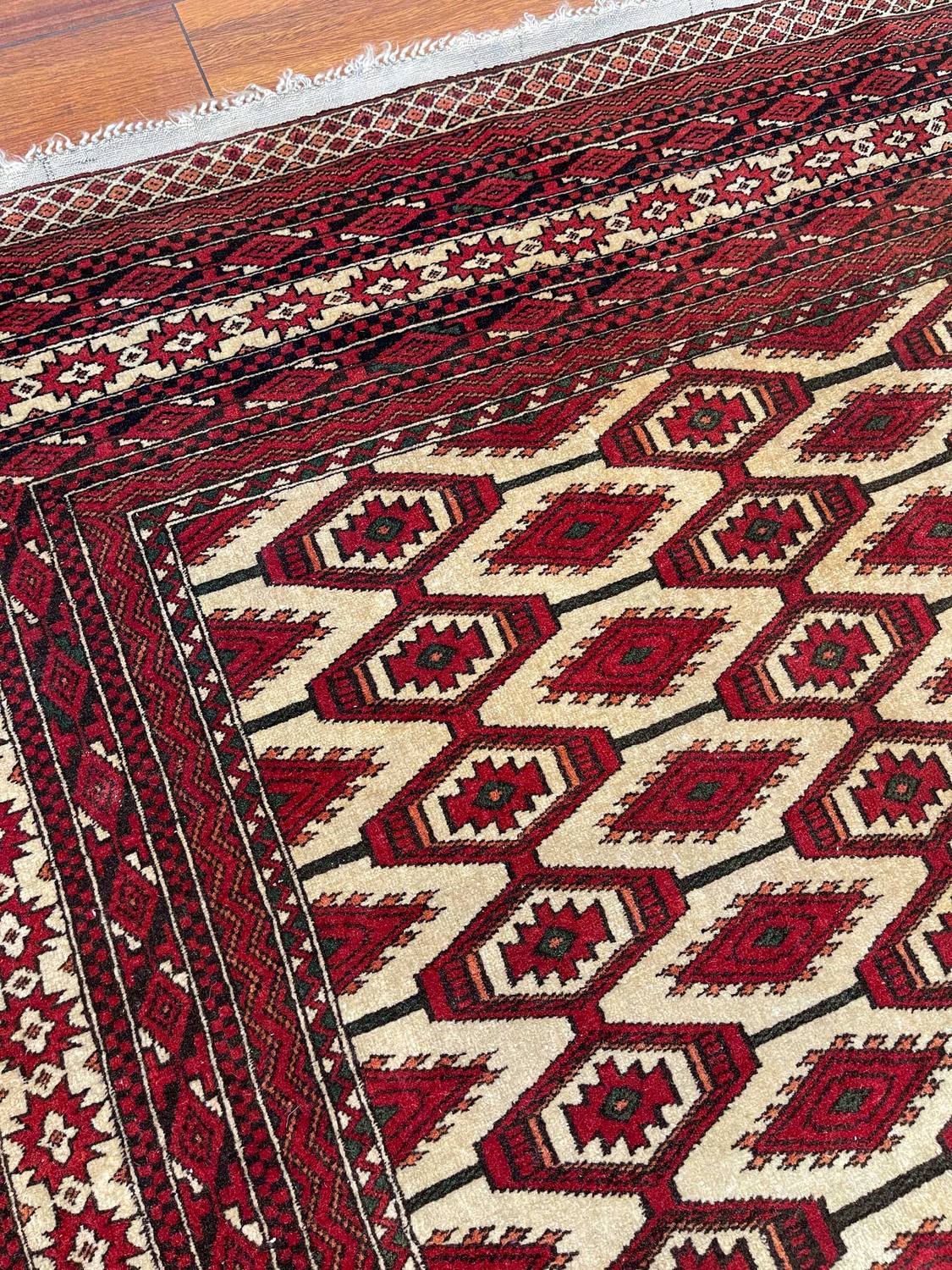
“Handmade” is one of the most over-used words in the rug trade, so it helps to know how to check for yourself. You do not need to be an expert. A few honest signs tell you most of what you need.
Turn it over
The back of a rug is the most reliable place to look. On a hand-knotted rug, the pattern is clearly visible on the reverse, and the knots are slightly irregular because a person tied each one. On a machine-made rug, the back is uniform and often has a stiff or gridded feel, and you may see a fabric or latex backing.
Look at the fringes
On most handmade rugs, the fringes are part of the rug itself — they are the warp threads that run through the whole piece. On many machine-made rugs, the fringe is sewn or glued on afterward as a decorative finish. If the fringe looks added rather than integral, treat it as a flag.
Read the knots and the weave
Hand-knotted pile is built one knot at a time around the warp threads. Under the pile you can often see the knots themselves. The two common knot types are the symmetrical (Turkish or Ghiordes) knot and the asymmetrical (Persian or Senneh) knot. You do not need to identify which; you only need to see that the structure was tied rather than printed or machine-tufted.
Welcome the irregularities
Small irregularities are a feature of handmade work, not a defect. A field of color may shift gently across the rug — this is called abrash, and it comes from natural variation in hand-dyed wool from different dye lots. Lines may waver slightly. Patterns may not be perfectly mirror-symmetric. These are the fingerprints of a person and a loom.
A machine-made rug, by contrast, tends to be flawlessly even, because it was produced to a fixed program.
Materials are a clue, not proof
Handmade rugs are usually wool, silk, cotton, or a combination, with natural fibres throughout. Many machine-made rugs use synthetic fibres such as polypropylene. Synthetic does not always mean machine-made, and natural fibres can be used in powerloomed rugs, so use material alongside the other signs rather than on its own.
When each makes sense
Machine-made rugs have their place: they are inexpensive, consistent, and easy to replace. But they do not hold value, and they do not carry the labour and history of a handwoven piece. A handmade rug is a different kind of object — closer to a textile artwork that you can also live on.
These same signs of craftsmanship are part of what makes a handmade rug valuable, and you can see the process behind them in how a hand-knotted rug is made.
If you are comparing two pieces and are unsure, send us clear photos of the front, the back, and the fringes. We are glad to tell you what we see.
Personal Selection
Looking for a piece like this?
Tell us your room size, colors, and budget, and we'll prepare a small selection from the gallery.
Request a SelectionKeep reading
More from the Journal
How to Choose a Handmade Rug for Your Home
A practical guide to choosing a handmade rug by size, origin, material, color, age, and condition — so the piece fits both your space and the way you live.
Read Buying AdviceWhat Makes a Handmade Rug Valuable?
Knot density, materials, age, condition, origin, and design all shape a handmade rug's value. Here is how to weigh them without falling for myths.
Read Istanbul & StoriesBuying a Handmade Rug in Istanbul
Istanbul has long been a meeting point for rugs from across the East. Here is how to buy well here — in person or from abroad.
Read